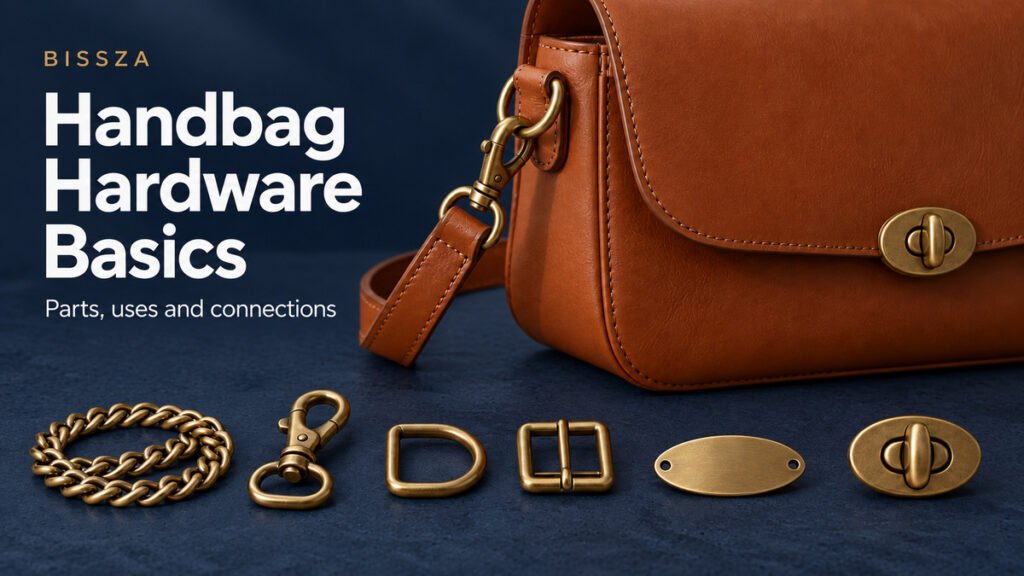
Bag Hardware for Leather Goods Production: A Selection Guide
Choosing bag hardware starts with the product plan: the leather weight, the load the bag must carry, and the finish of the whole line. These decisions shape which rings, hooks, chains, and buckles belong in the spec.
How bag hardware affects durability and usability in leather goods
Hardware earns its place in leather goods when it carries weight, manages movement, or protects high-contact areas. For a weekend bag, tote, travel pouch, or structured handbag, that usually means rings for bags, strap connectors, zipper pulls, hooks, chains, feet, buckles, and reinforcement plates. These parts are not decorative afterthoughts; they determine how the bag opens, how the strap sits on the shoulder, and how well the leather holds up through repeated use.
In production planning, the shift is to specify hardware early. Instead of sourcing generic accessories at the end of a project, product teams now plan handbag hardware and purse hardware at the pattern stage. That makes it easier to choose compatible colors, common market sizes, and suitable materials before holes are punched or seams are set.
Core hardware pieces define strength and usability
Bag rings remain one of the most widely used components in leather luggage accessories because they create flexible connection points. They are commonly used where handles, crossbody straps, shoulder straps, luggage tags, and detachable pouches need movement without tearing the leather. Round rings, D-shaped rings, oval rings, and rectangular rings each create a different look and distribute tension differently, so the shape should match both the design and the strap direction.
In practice, ring size is decided before finish — a strap-width mismatch is the most common rework in production.
Bag strap hardware is equally important. Sliders allow adjustable straps, loops keep loose strap ends controlled, and swivel clasps help prevent twisting while the bag is being carried. A lobster hook clasp (also sold as a snap hook) is often chosen for removable shoulder straps, key leashes, camera-style bag straps, and small travel accessories because it opens quickly and rotates easily when paired with a compatible ring.
Zipper pulls add another practical layer. On leather luggage, a strong pull makes a zipper easier to use when the bag is full, when hands are cold, or when the leather is stiff. Pulls can be minimal and flat, oversized for travel convenience, or decorative enough to become a design feature.
Common hardware choices in leather bag production include:
- Bag rings:Used for handles, detachable straps, luggage tags, and side anchors.
- Lobster hook clasps:Useful for removable straps, key holders, and convertible bag designs.
- Zipper pulls:Added to pouches, travel organizers, duffle bags, and handbags for easier opening.
- Handbag chain:Used as a strap, trim detail, handle accent, or decorative connector.
- Buckles and sliders:Selected for adjustable shoulder straps and luggage belts.
- Feet and protective studs:Applied to the base of leather bags to reduce surface wear.
- Connector plates and tabs:Used when a project needs extra reinforcement around stress points.
Commercial spec cards for the seven core types

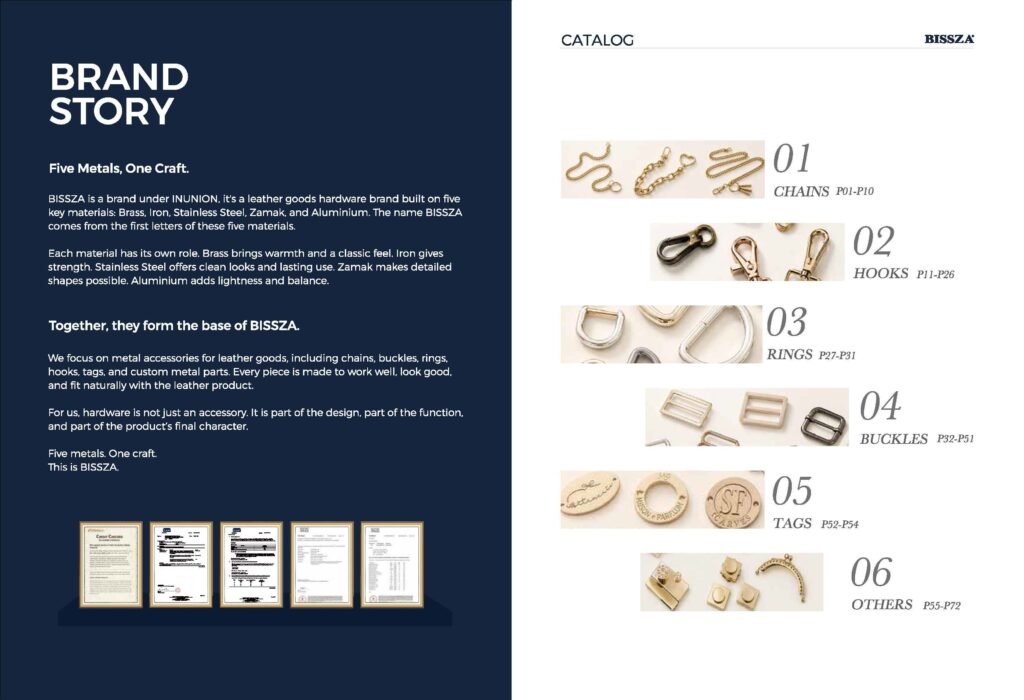
The spec cards below cover the seven hardware types listed above for production and sourcing decisions — key dimensions in millimeters, material and structure, finish and logo options, target application, and what to confirm before ordering. Dimensions and item numbers follow the BISSZA 2027 catalog; finishes and logo options are standard candidates to confirm per style.
Bag rings (D-rings, O-rings, rectangle, triangle, key rings)
Key dimensions: wire diameter × inner diameter from 2.5 × 13 mm to 6.0 × 50 mm (D, O, rectangle, triangle); key rings: 1.0 × 12 mm to 2.0 × 45 mm (outer diameter).
Material and structure: steel or stainless steel drawn rings; zinc-alloy (zamak) versions for decorative shapes.
Finish and logo: polished gold, antique brass, gunmetal, matte black; flat surfaces accept logo stamping.
Application: handles, detachable straps, luggage tags, side anchors; mid-to-upper price points.
Confirm before ordering: inner diameter vs. strap width, load rating, plating durability, logo position, packaging.
Lobster hook clasps and snap hooks
- Key dimensions: overall length × width from 29 × 8 mm to 117 × 30 mm across the catalog range.
- Material and structure: brass or stainless steel; spring-loaded gate for one-hand release.
- Finish and logo: polished gold, antique brass, satin or polished stainless steel; engraving on the gate or body.
- Application: removable shoulder straps, key leashes, convertible bag designs.
- Confirm before ordering: gate opening width, spring cycle life, break strength, finish match, MOQ.
Zipper pulls
- Key dimensions: length × width from 20 × 5 mm to 39 × 12 mm.
- Material and structure: die-cast zinc alloy (zamak); loop or bar that fits standard zipper sliders.
- Finish and logo: plated finishes with embossed or stamped logos; decorative shapes available.
- Application: pouches, travel organizers, duffle bags, handbags.
- Confirm before ordering: slider compatibility, pull-hole size, plating durability, logo artwork, sample.
Handbag chain
- Key dimensions: cable and curb chain 0.5–5.0 mm wire gauge, rope chain 1.0–9.0 mm, link chain 1.0–5.0 mm, BL/BSK styles 2.0–10.0 mm; coffee-bean chain 5.0–11.0 mm in stainless steel; sold by spool or cut length.
- Material and structure: brass, steel, or stainless steel; coffee-bean chain is stainless steel only.
- Finish and logo: polished gold, antique, gunmetal; end fittings accept logo stamping.
- Application: strap, handle accent, trim detail, or decorative connector.
- Confirm before ordering: gauge vs. load, link construction and soldering, finish, cut lengths, end fittings.
Buckles and sliders
- Key dimensions: inner width from 13 mm to 39 mm in the solid brass series.
- Material and structure: solid brass; steel and zinc alloy available on request.
- Finish and logo: polished or antique brass; logo engraving on the center bar.
- Application: adjustable shoulder straps, luggage belts, structured bags.
- Confirm before ordering: strap width vs. inner width, bar strength, finish, logo placement.
Feet and protective studs
- Key dimensions: bag protection corners from 14 × 2.5 × 2 mm to 30 × 7 × 4 mm; prong studs 2–15 mm inner diameter; button studs 4–12 mm head diameter.
- Material and structure: iron protection corners; brass and steel prong and button studs.
- Finish and logo: antique or polished finishes with anti-scratch coating.
- Application: base protection on totes and structured handbags, high-contact areas.
- Confirm before ordering: foot height clearance, prong length vs. leather thickness, fixing method, finish.
Connector plates, tabs and tags
- Key dimensions: dog tags from 38 × 22 mm to 66 × 41 mm, thickness 0.4–1.8 mm; custom logo tags in various sizes.
- Material and structure: brass, stainless steel, or aluminium plates; flat or formed tabs.
- Finish and logo: brushed or polished finish; laser engraving, embossing, or printed logos.
- Application: brand labels, reinforcement plates at stress points, decorative connectors.
- Confirm before ordering: artwork file, plate thickness vs. leather pocket, fixing holes, finish, sampling.
Materials are shaping buying decisions
Material choice is one of the clearest differences between basic bag accessories and hardware intended for leather goods. Brass bag hardware is popular because it has a substantial feel, develops character with use, and pairs naturally with full-grain and vegetable-tanned leather. Solid brass is often chosen for premium production runs, travel satchels, and heritage-style luggage accessories where weight and finish are part of the appeal.

Zinc alloy hardware is common in many handbag hardware and purse hardware assortments because it supports a wide range of shapes, finishes, and decorative designs. Stainless steel is often favored when corrosion resistance is a priority, especially for travel pieces that may be exposed to weather, humidity, or frequent handling. Iron hardware may appear in budget-friendly accessories, but product teams usually look closely at coating quality and long-term resistance to wear.
For heavier leather luggage, hardware should feel proportionate to the product. A thick leather duffle needs sturdier rings and strap connectors than a small card pouch or soft clutch. Size follows the same logic: in the BISSZA catalog, ring wire diameters run from 2.5 mm to 6.0 mm and chain gauges from 0.5 mm to 10.0 mm, so the range covers everything from compact accessories to heavy travel bags. The right choice is not the biggest available part, but the one that suits the leather thickness, strap width, and expected carrying weight.
On budget lines, coating quality fails before the base material does, so plating specs deserve the same scrutiny as the metal grade.
Color finishes are moving beyond basic silver
Finish selection has become a major design decision for product development teams. Classic silver-tone hardware remains versatile, especially for black, gray, and cool-toned leather. Gold-tone hardware gives leather goods a polished look and is often used on handbags, travel wallets, and structured pieces where a refined finish is desired.
Antique brass and antique bronze continue to work well with brown, tan, chestnut, and distressed leather. These colors help create a vintage luggage mood without making a new project feel unfinished. Gunmetal and matte black finishes are often selected for modern travel bags, urban backpacks, and minimalist leather accessories.
Some product lines also take inspiration from luxury handbag details, including the look of high-end polished and antique hardware. In production work, that influence usually appears in lock plates, strap bridges, polished metal accents, and carefully matched hardware sets. Use these references as design inspiration only; copying branded hardware designs raises IP and compliance issues.
A consistent finish across the set does more for the finished look than any single premium part.
Application scenarios guide the right choice
Different leather luggage accessories place different demands on hardware. A slim passport holder may only need a small zipper pull or snap, while a travel tote may require reinforced rings, strap sliders, magnetic closures, and base protection. A weekender bag needs hardware that can handle movement, weight, and repeated lifting from handles and shoulder straps.


For detachable straps, designs often combine rings for bags with lobster hook clasps or swivel hooks. This gives the bag more flexibility, allowing it to move from hand carry to shoulder carry. For travel organizers, zipper pulls and small hooks can improve access and keep keys, tags, or removable pouches secure inside a larger bag.
Handbag chain is useful when the design calls for a dressier strap or a mixed-material effect. It can be paired with leather shoulder pads for comfort or used as a short handle accent. For luggage-style projects, chain is often most effective as a controlled design detail rather than the main load-bearing element, unless the chain and attachment points are suitable for the expected use.
Specs before samples is the cheapest quality control a product team can buy.
Practical selection tips for production planning
Before installing hardware, test the fit, finish, and movement of every component. Leather is less forgiving once it has been cut, punched, and stitched, so hardware planning can prevent costly mistakes. Matching the hardware to the pattern early also helps create a more professional final result.
Use this checklist before committing to a hardware set:
- Match the metal strength to the bag’s expected load and leather weight.
- Choose common market sizes that suit the strap and overall bag proportion.
- Keep finishes consistent across rings, hooks, zipper pulls, chain, and buckles.
- Test moving parts, especially clasps, sliders, and zipper pulls, before installation.
- Reinforce stress points with leather tabs, extra stitching, or backing pieces where needed.
- Consider comfort as well as style when selecting handbag chain or heavy connectors.
- Avoid overly delicate hardware on travel bags that will be carried often.
What happens next in leather bag hardware sourcing
The next stage in leather bag hardware is more complete hardware planning. Product teams want coordinated sets that include bag rings, strap hardware, zipper pulls, hooks, and matching decorative pieces in the same finish. That shift helps production teams and private-label programs create bags that look intentional from every angle.
Demand context supports this direction. Analysts estimate the global leather goods market at USD 478.8 billion in 2025, with a projected 6.7% CAGR from 2026 to 2035 (Market Research Future, 2026). The same report links growth to rising disposable incomes and a premiumization trend in which consumers combine functionality, craftsmanship, durability, and fashion. For hardware planning, that points to coordinated, finish-consistent sets rather than single replacement parts in bulk sourcing.
Coordinated sets are replacing mixed sourcing, which is why finish consistency keeps moving up the buying criteria.
FAQ: bag hardware selection for production
- How do I match bag hardware to leather thickness and expected load?
Start with the load and strap width: heavier bags and wider straps call for thicker ring gauge and stronger connectors. As a working range, BISSZA rings run from 2.5 × 13 mm to 6.0 × 50 mm (wire × inner diameter) and chains from 0.5 mm to 10.0 mm wire gauge. Confirm strap width against ring inner diameter before sampling.
- Brass, stainless steel, zinc alloy, or iron — which suits which product line?
Brass suits classic and mid-to-upper lines; stainless steel suits travel and corrosion-sensitive products; zinc alloy (zamak) suits decorative shapes and complex finishes; iron suits economy components. For perceived durability, plating quality often matters more than the base metal, so confirm the plating spec per order.
- How do I keep finishes consistent across rings, hooks, chains, and buckles?
Fix one finish family for the whole set and source the set in the same production run. BISSZA covers polished gold, antique brass, gunmetal, matte black, and plated options across the catalog, so matching parts can be ordered together.
- Can hardware be customized with my logo and specific sizes?
Yes — custom bag hardware accepts laser-engraved, embossed, or stamped logos on rings, clasps, tags, and buckles, and sizes can be adjusted within tooling limits. Confirm logo artwork, placement, and finish with the supplier before sampling.
- What should I confirm before placing a bulk bag hardware order?
Confirm dimensions, material, finish, logo artwork, plating durability, packaging, and any required test documents before production. Catalog item numbers and sizes — the BISSZA 2027 catalog for this project — are the reference points for every bulk order.
- Do you offer samples, and what is the MOQ for bulk orders?
Sample policy and MOQ depend on the item, material, and finish; confirm both with the supplier before committing.
As durability and finish quality keep rising in importance, hardware remains a defining part of leather bag design. The right pieces add structure, movement, security, and visual polish. For any new product plan, hardware selection belongs near the top of the spec.
Tell us your bag type and target finish — we will shortlist the hardware for you.