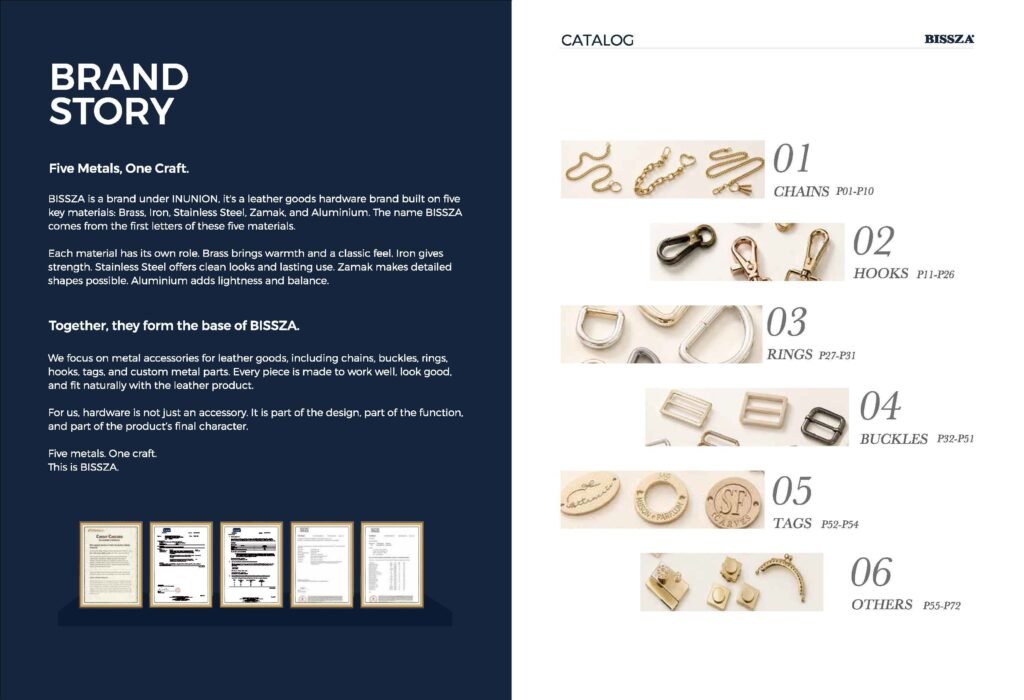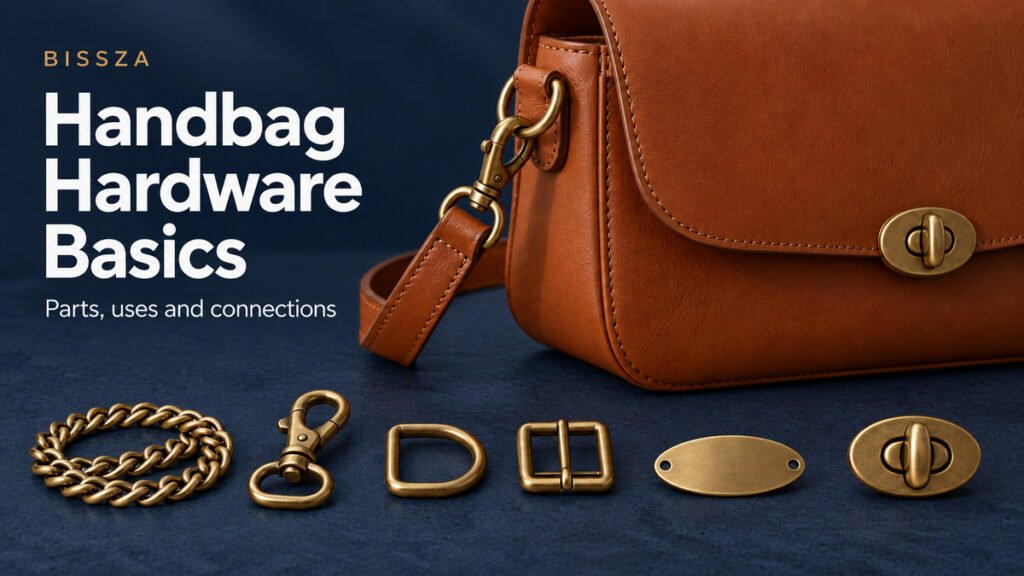
How are rope chains made, and what should you check before one is fitted to a bag? Their rope-like pattern comes from small metal links connected in a repeating spiral. Link forming and assembly affect how evenly the chain hangs, while finishing and end connections affect its fit with other hardware. This guide follows those production steps and turns them into practical checks for a leather goods project.
What makes a rope chain look and move like a rope?
Look closely at a rope chain and you will see many small metal links, not one solid piece of twisted metal. Each link passes through its neighbors in a repeating arrangement. Together, the links create the raised, spiral pattern that gives the chain its name. The spaces between them let the chain bend and hang.

That construction matters when you compare samples. Two chains can have a similar overall size but different link shapes, spacing, or assembly. One may show a tight, even spiral; another may look uneven when it hangs from a bag. Flex a short sample, lay it flat, and inspect the pattern along its length. If a supplier calls a different twisted or braided construction a “rope chain,” ask for a close-up sample or construction drawing before assuming it is made from interlocking links.
How are rope chains made, step by step?
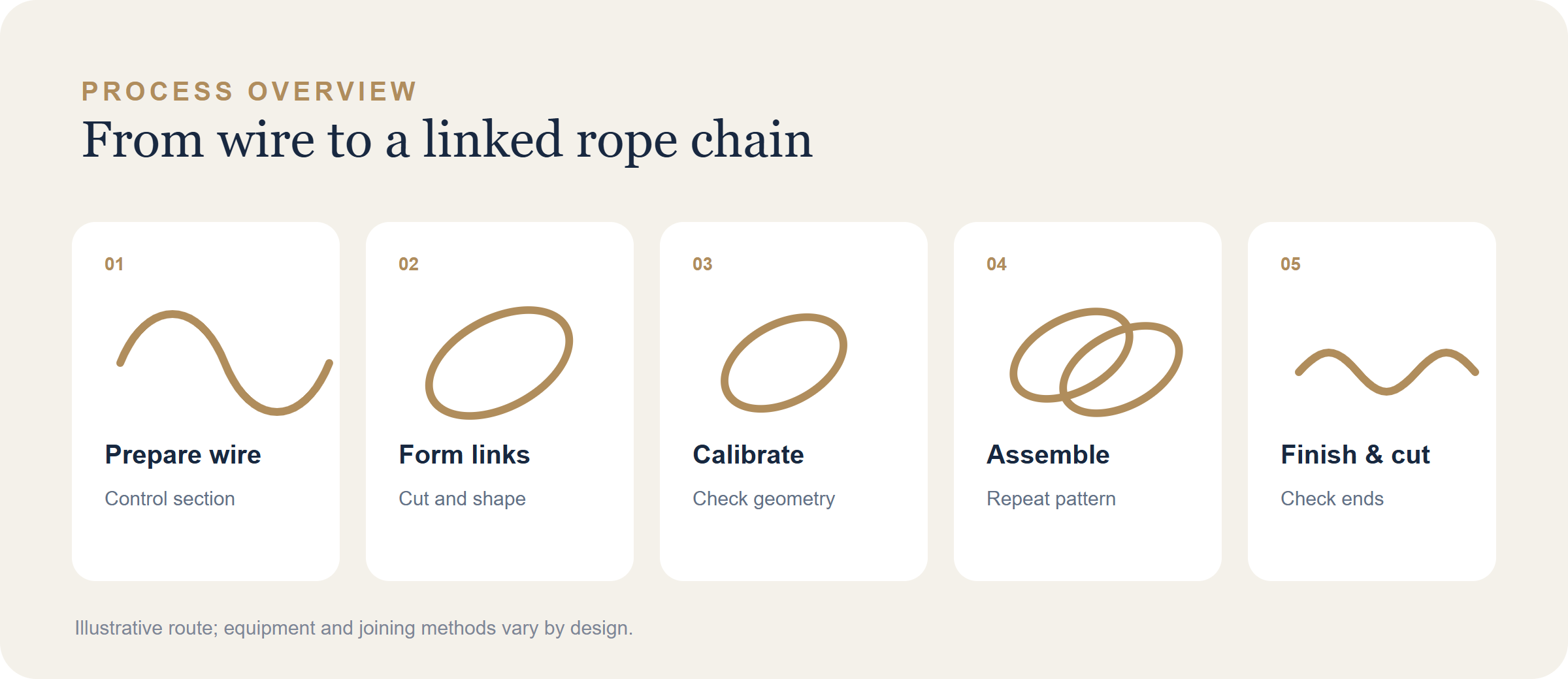
For the interlocking-link style discussed here, production follows a clear sequence: prepare the metal wire, form and size the links, assemble the repeating pattern, secure joints where the design requires it, and finish the chain. The exact machines and joining method vary by manufacturer and specification. The stages below describe a documented production route, not an assertion that every factory uses identical equipment.
Material and wire preparation
The starting material is prepared as wire with a controlled cross-section. Its size must suit the intended link and finished chain. If the wire varies, the formed links can vary too, even when the assembly machine is set correctly. You should therefore treat wire size as a separate specification from the finished chain size.
Some production routes use solid wire; others can form links from hollow stock. “Solid” and “hollow” describe the construction of the stock, not whether it is brass, steel, silver, or gold. They can change weight and the way a link responds to forming. Neither label alone proves that a finished bag strap will carry a given load.
Link forming and calibration
The wire is cut and shaped into individual links. Before assembly, the links need consistent dimensions. For example, Ciemmeo’s documented rope-chain process forms open links, then calibrates their inner and outer dimensions and thickness before feeding them into an assembly machine. Other equipment may combine these operations.
The commercial point is simple: small differences repeated hundreds of times become visible across a full strap. Ask for a longer sample, not just a close-up of one good section. Check whether the spiral stays even and whether the chain bends smoothly without isolated stiff spots.
Spiral assembly
The prepared links are fed through one another in a consistent sequence. Their orientation and overlap create the rope-like ridges. The chain must remain flexible, but the pattern should not open up or drift from one section to another. In an automated route, calibrated links are assembled continuously; other designs may use different machinery or more manual handling.
You can assess the result without knowing the machine model. Hang the sample vertically, turn it under steady light, and compare several sections. Look for repeated texture, a consistent outline, and an even drape. If you plan to use two visible chain sections on one bag, approve them together so their appearance matches.
Joint securing
Depending on the design, link openings may be closed or soldered during assembly. The Ciemmeo assembly machine, for example, laser-solders links as it builds the chain. That is one manufacturing method, not a universal requirement for rope chains or a claim about BISSZA’s equipment.
For a buying decision, examine what the process leaves behind. A joint should match the approved construction, and an exposed opening or rough edge should not snag leather, lining, or clothing. If the chain will carry weight, agree with the supplier on how the complete chain and its end fittings will be tested. Visual inspection alone cannot establish a safe load.
Surface finishing, cutting, and end connections
The assembled chain may be cleaned, polished, and given the specified surface finish. It can then be supplied on a spool or cut to the length needed for the product. Cut ends need their own inspection: a chain that looks smooth in the middle can still have a sharp terminal link.
For a bag, the end connection is part of the specification. Confirm how the chain attaches to its ring, clasp, or leather tab, and review the finish color with those parts beside it. A good chain body cannot compensate for a weak or mismatched connection.
| Production stage | What you can see on a sample | What to confirm before ordering |
|---|---|---|
| Wire and link preparation | Consistent link size and outline | Base metal, stock construction, and link dimensions |
| Assembly and joint securing | Even spiral, smooth movement, no exposed gaps | Construction and joint requirements for the approved style |
| Finishing and cutting | Consistent color and clean cut ends | Finish reference, cut length, and end treatment |
| End connection | Chain sits correctly with the bag hardware | Ring or clasp fit and any required assembly test |
Which materials can a rope chain use, and why does the choice matter?
Keep base metal, solid or hollow construction, and surface finish separate on your specification sheet. A gold-colored chain may be plated brass or steel; its color does not tell you what metal is underneath. A hollow link is a structural choice, not a material grade.

In leather goods, brass, steel, and stainless steel are real rope-chain options: all three appear in BISSZA’s Rope Chains catalog. Brass is useful when you want a substantial feel and a particular plated or natural-brass appearance. Steel is another option, but the finish and exposed cut ends deserve attention where moisture or abrasion is expected. Stainless steel can be considered when corrosion resistance is a priority; ask which grade and surface treatment the supplier is actually quoting. These are selection factors, not a promise that every material will suit every strap design.
Some market listings also offer zinc alloy or aluminum as custom material options for rope-style bag chains. Treat these as project-specific possibilities: ask for the actual link construction, finish, and sample before comparing them with a cataloged brass, steel, or stainless steel chain.
The wider market also includes precious-metal rope chains. 14K gold rope chains and 925 sterling silver rope chains are sold for jewelry. Their presence in search results does not make them standard materials for a handbag chain, and a gold or silver finish on bag hardware should never be described as solid gold or sterling silver.
When you request quotes, name the base metal, link construction, finish, intended use, and whether you need chain by the meter or cut lengths. Then compare samples at the same finished size and length. Otherwise, two quotations for a “gold rope chain” may describe very different products.
Which rope chain dimensions should you specify?
A single number marked “size” rarely tells a supplier enough. You need to distinguish the finished chain’s outside dimension from the wire or link section, the dimensions of an individual link, the cut length, and the opening or fitting at each end. These measurements answer different questions: how the chain looks, how it bends, how much room it needs on the bag, and whether it can connect to the chosen hardware.
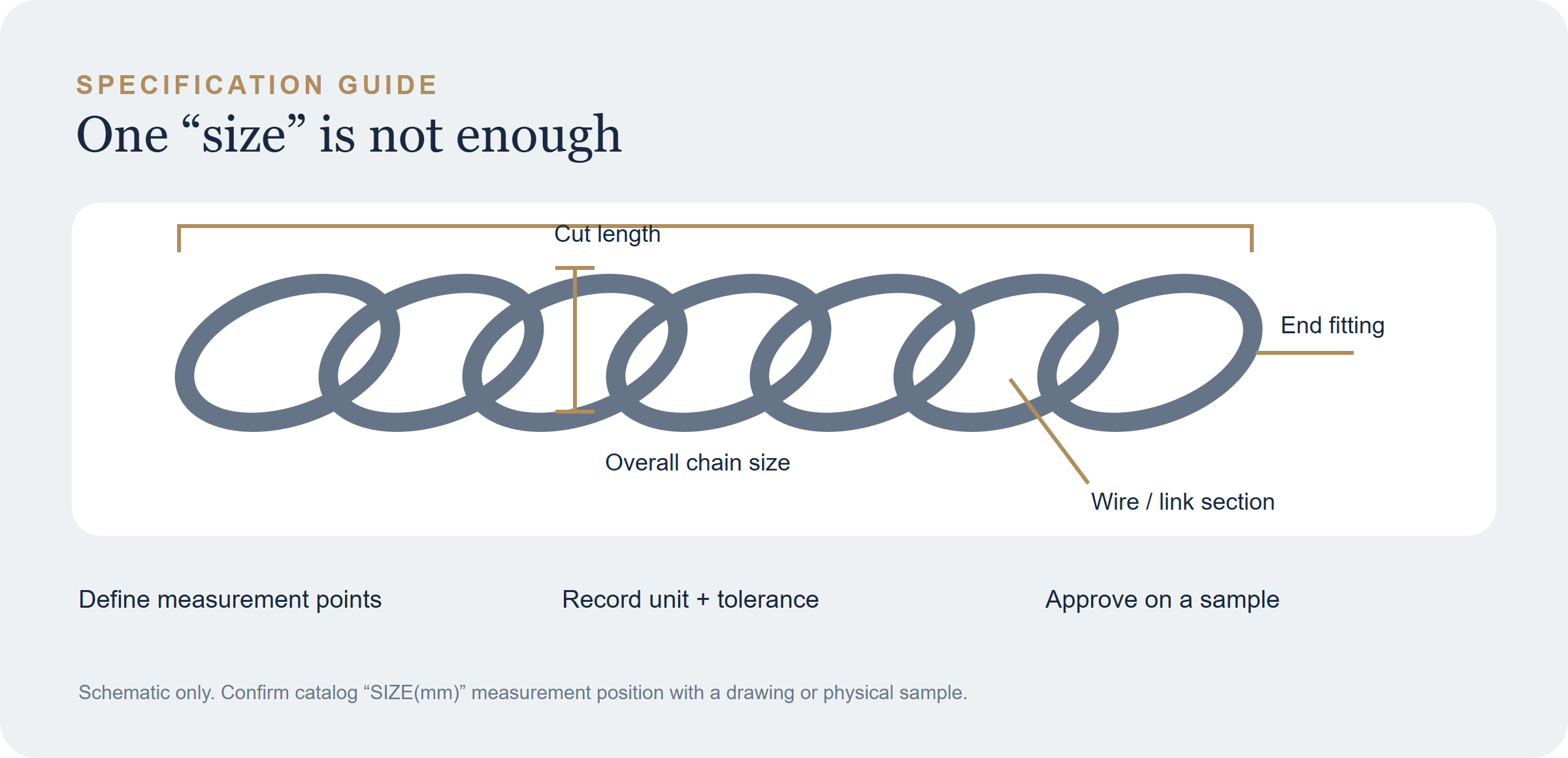
Real catalog ranges show why the measurement label matters. BISSZA’s 2027 Rope Chains catalog lists ROP1.0, ROP1.5, ROP2.0, ROP2.5, ROP3.0, ROP4.0, ROP5.0, ROP6.0, ROP7.0, ROP8.0, and ROP9.0, with corresponding SIZE(mm) values of 1, 1.5, 2, 2.5, 3, 4, 5, 6, 7, 8, and 9 mm. The catalog does not define the measurement position, so confirm it on a drawing or physical sample before calling it wire diameter or finished chain width.
Other suppliers describe their numbers differently. A bag-chain product specifies 3.1 mm and 6.3 mm chain diameter/width. A brass rope-chain catalog lists a 6 mm style sold by the meter, without using the same measurement wording. These are actual market examples, not interchangeable standards or evidence of BISSZA stock in those exact forms.
Before approving a size, record the item code, the exact points measured, units, tolerance, cut length, end-fitting dimensions, and finish. Ask the supplier to mark the measurements on a sample photo or drawing. For a shoulder strap, compare the finished assembly on the bag; a chain that looks proportionate on a table can hang differently once connected to leather and hooks.
How should you evaluate a finished rope chain for your product?
Start with the chain’s role in your product. A decorative detail on a leather bag, a short handle accent, and a load-bearing strap do not have the same demands. Other accessories may place the chain against different materials or use different connectors. For decoration, visual consistency and a clean finish may lead the review. If the chain carries weight, assess the chain, terminal links, connectors, and attachment points as one assembly.
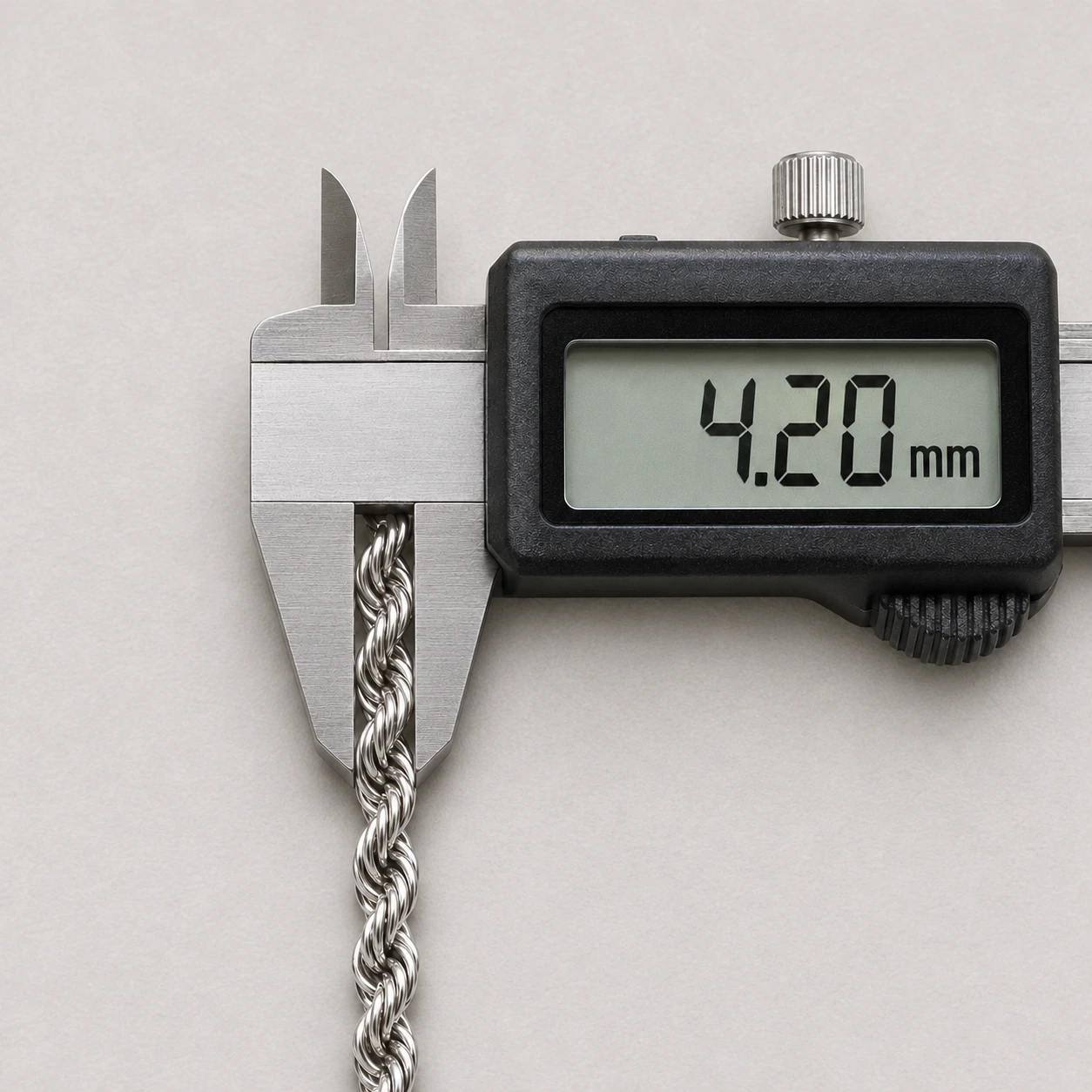
Use the approved sample and specification sheet as your reference. Measure at several points along the chain. Check the spiral under consistent lighting, then bend and hang the sample to look for stiffness or uneven twist. Check cut ends and joints for edges that could catch on the material beside the chain, whether that is leather, lining, or fabric. Compare the finish beside the actual adjoining components, because a color match judged from separate photos can be misleading.
Finally, test the complete assembly under conditions that reflect its intended use. Agree on the test method and acceptance criteria before bulk production; do not infer strength from nominal chain size. Record the approved material, catalog code, length, finish, end fitting, and reference sample so the next production batch can be checked against the same requirements.
FAQ
Why can rope chains with the same listed size receive different quotes?
How long can a rope chain last in a finished product?
Can rope chain be ordered in continuous lengths or pre-cut pieces?
What should you provide when matching an existing rope chain sample?
Why might a custom rope chain size require new sampling or tooling?
How do you confirm that a rope chain finish matches its connectors?
What packaging helps prevent rope chains from tangling or scuffing?
Final Thoughts
Understanding how a rope chain is made helps you ask better questions about its links, material, dimensions, joints, and finish. The useful decision comes when you compare a complete sample with the way your product will actually use it. BISSZA’s rope chain catalog provides material and size options to review. Share your intended use, target dimensions, finish, and end connections so the right specification can be assessed before production.